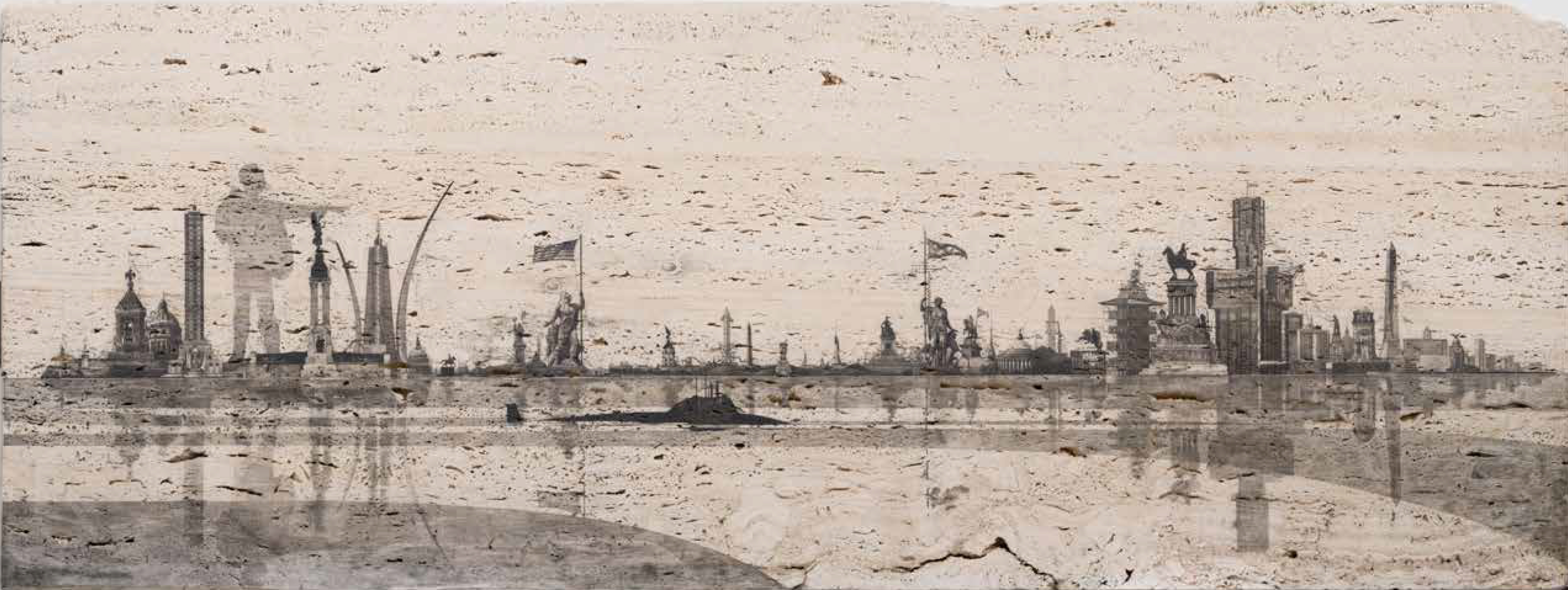
Art & Histories, Havana-Washington Island 2025 graphite on marble, 18 x 48 inches (45.7 x 121.9 centimeters). David Castillo Gallery, Miami.
As literally the journey of my life itself, this is the research that I performed to produce this piece. I discovered monuments and iconic locations in the cities of Havana and Washington, DC, with the intention of collecting an archive of images. This compendium of signs, packed with an intricate vocabulary, could well express the history of both nations, including notes on European colonizers and American liberators.
The same process led me to review a history saturated with dramatic events: wars, slavery, autocratic crises, blood and many deaths, perhaps too many martyrs. I revisited the experience of being a child indoctrinated in Marxism-Leninism, under the dogmatic word of an absolute leader and an Argentine commander. He was trying to create “the New Man” prior to the technology of deoxyribonucleic acid (DNA). All this made me recognize, very early on, the ideological programs hidden by the aesthetics of power—in the ideograms of the Chinese Cultural Revolution or the persistent runes of the Cyrillic language of the Kremlin. As well, I participated in the political scenography spectacle, which covers the appearance of a city and all private spaces with centralized propaganda.
I Learned how to live in a bubble, what today in the distance could be the past. Outside there was a real world, from which today I enter and leave, as the future. This leads me to have points of view from very peculiar perspectives—without iron curtains, without ever seeing the wall fall. The experience of exile became real, independent, and, at the same time, a vehicle to reread that forbidden history. That obsession, like a kind of nomadic doctrine of searching for horizons, collecting spaces, trying to dilute the panoramas and silhouettes of the cities, or decoding the discourse of the landscapes, has become the axis of my career. I have ended up telling stories using the encryptions that I have discovered along the way.
Art & Histories, Havana-Washington Island is a sort of compilation of enigmas, with which Ican describe the intricate connection of these two nations, represented by the capitals of Havana and Washington, DC, that for so long have coexisted, almost dependent, against all possible odds. That is why I describe it as a unique panorama, represented on a large solitary island, where the monuments that speak of its history rest within a postapocalyptic metropolis. Perhaps inspired by the extensive solemnity of Arlington National Cemetery, the work is an exercise on the persistence of return, like the circular trip between a mother’s and grandparents’ houses.
Glexis Novoa, Miami, 2024
This work was commissioned by the National Gallery of Art, Center for Advanced Study in the Visual Arts, to be part of the publication ‘Art & Histories‘ (Volume 1). Published January 31, 2026.
Edited by Kaira M. Cabañas
Each essay in this groundbreaking volume—the first in an exciting new series from the Center for Advanced Study in the Visual Arts—engages aesthetic and cultural debates that situate research on the arts at the intersection of various disciplines, including architecture, film, literature, curatorial and museum studies, and the arts of performance. Reflecting the series’ goal to engage with different cultural contexts and time periods, newly commissioned essays from emerging and established scholars address subjects ranging from medieval dance and ancient Assyrian reliefs to expressions of gender embodiment and the art of the Afro-Atlantic. First-person narratives ground theoretical considerations of the theme.
Reflecting a commitment to embracing the book form as a space for art itself, Art & Histories includes a detachable accordion-fold insert with a work from Miami-based artist Glexis Novoa. One of his signature horizon lines unites Washington, DC, and the artist’s native Havana. Meticulous drawings executed on travertine marble entangle the two cities and their monuments, symbolizing both violent and triumphant histories and their ideological reversals.
Published by the National Gallery of Art, Center for Advanced Study in the Visual Arts
Distributed by Yale University Press